Blog

  • The Trouble With Pressure

    The Trouble With Pressure


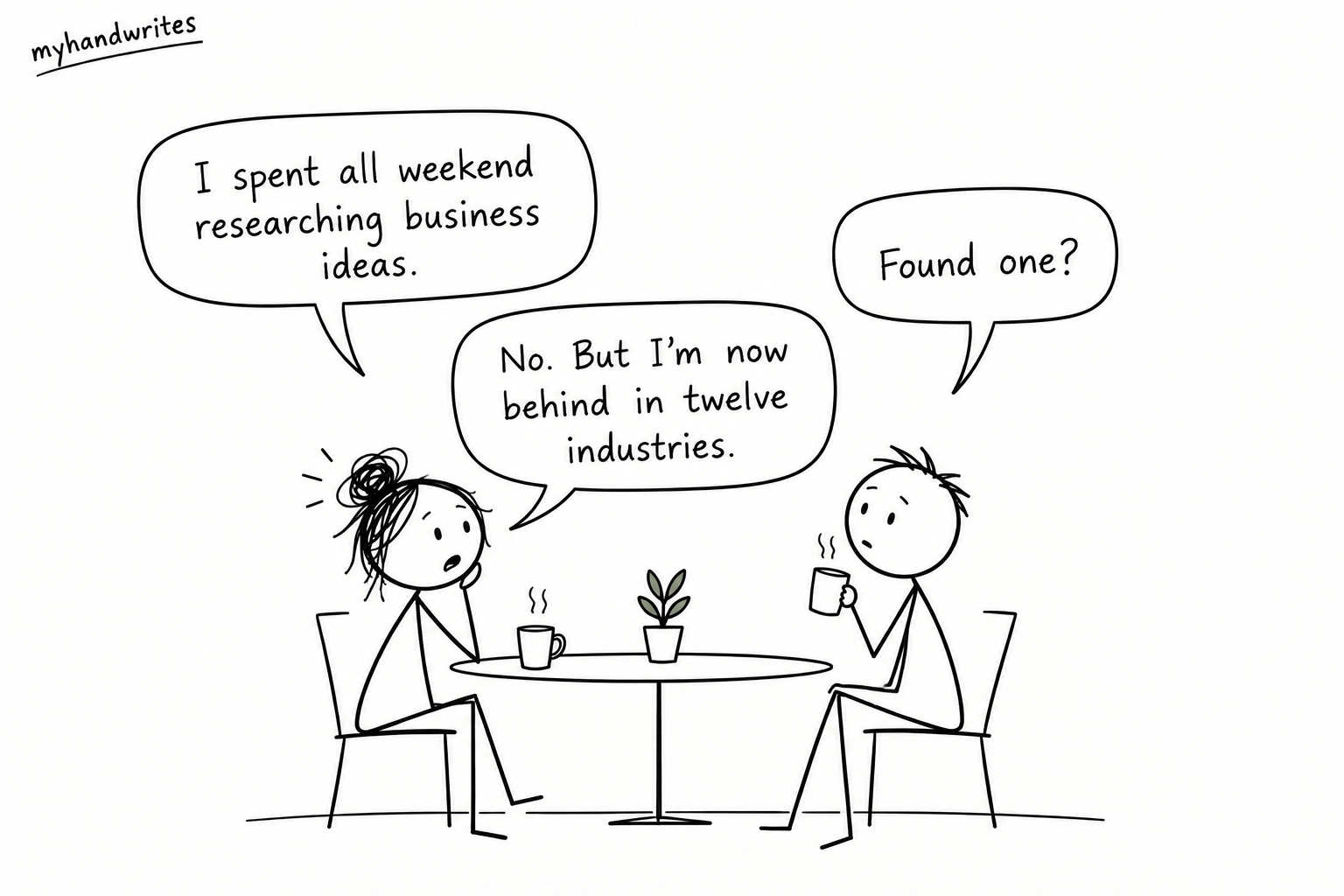
    I’LL JUST GET THROUGH THIS WEEK.

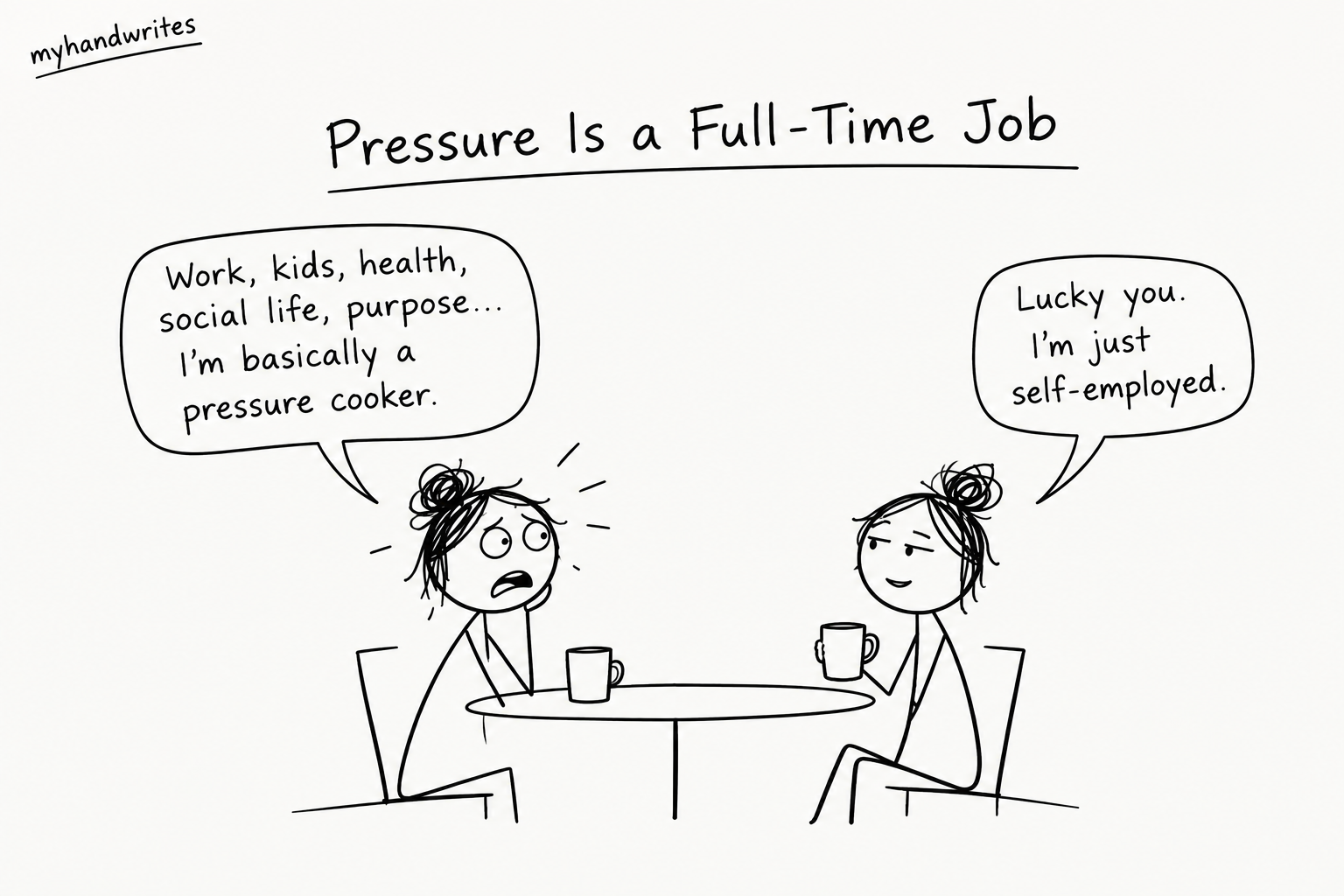
    Work pressure is a bit like tyre pressure. Too little and you don’t get very far. Too much and eventually someone starts checking whether you’re about to explode. So we keep adjusting it. One more deadline. One more meeting. One more “quick thing.” One more email sent at 11:47 p.m. Eventually, being permanently inflated starts looking suspiciously like competence.

    WHY IS THE BANANA BROKEN?

    Parenthood comes with its own pressure. More like a hot-air balloon. You keep adding air and hoping everyone stays airborne. Breakfast. Shoes. Nursery. Lost teddy. Forgotten water bottle. A child crying because the banana has been cut incorrectly. Somehow you are responsible for keeping another human emotionally stable while you haven’t had coffee yet. And still, every morning, you launch.

    MY WATCH SAYS I’M DOING IT WRONG.

    Then there is health pressure. Sleep eight hours. Exercise. Eat vegetables. Drink water. Reduce stress. Get enough sunlight. Your phone reminds you to stand. Your watch judges your sleep. Your app congratulates you for walking 8,000 steps, but quietly lets you know that 10,000 would have been more appropriate. At this point, you’re not sure whether you’re looking after your body or managing it.

    WHAT WILL PEOPLE THINK?

    Social pressure is particularly impressive because nobody actually hired us for this job. Yet somehow we know the requirements. Have a good career. Be a good parent. Look healthy. Travel. Have hobbies. Be successful, but not annoyingly successful. Be happy, but not suspiciously happy. And whatever you do, make it look effortless. There is apparently a performance review happening somewhere. We just haven’t found the manager.

    SO… WHAT IS YOUR PURPOSE?

    And then, just when you thought being alive was enough, someone asks about your purpose. You need a calling. A mission. A five-year plan. Ideally something that sounds good on LinkedIn. We are expected to know what we want to do with our one precious life while occasionally forgetting why we walked into the kitchen.

    Maybe pressure isn’t always about how much we can handle.

    Maybe sometimes it is about how many things we have quietly decided we are supposed to handle.

    And perhaps the first pressure valve is simply admitting:

    Some of this is ridiculous!

    ~ Megha.

    myhandwrites.com


  • The Shame Department

    The Shame Department

    Shame has an extraordinary memory.

    You can forget your mother’s birthday, your Wi-Fi password and why you walked into the kitchen. But shame remembers the exact sentence you said at a dinner party in 2018 that nobody else remembers.

    Nobody.

    Shame does.

    It probably has it backed up to the cloud.

    Shame also has impeccable timing.

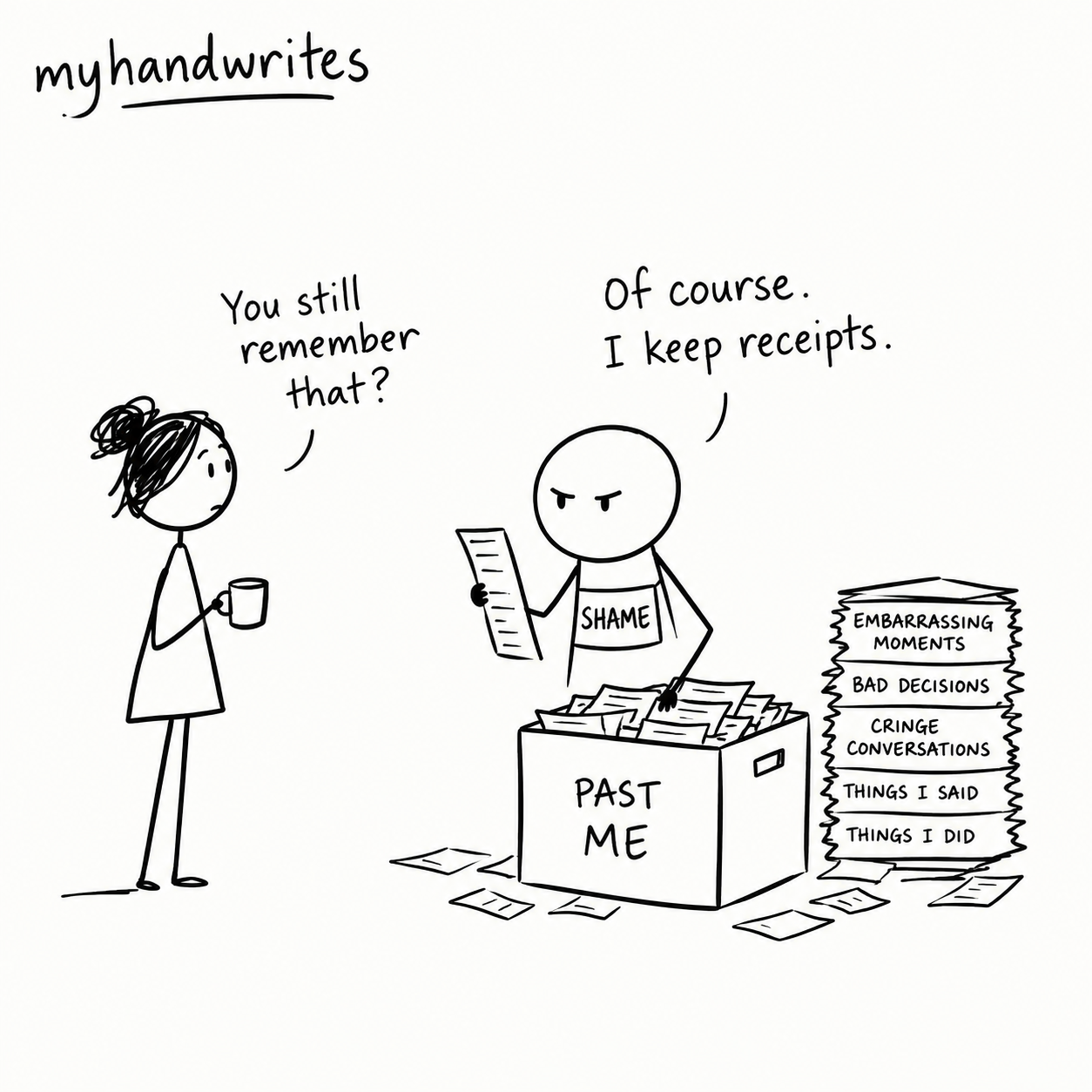
    You can be having a perfectly good day when it suddenly walks into your brain wearing a tiny security badge.

    Shame : “ Excuse me. We have an incident from 2024.”

    Me : I don’t work here anymore.

    Shame : “That is not relevant.”

    Shame doesn’t care much for your achievements either.

    You could get promoted, buy a house, raise a child and finally learn how to fold a fitted sheet. Shame will still be interested in that one time you said “you too” when the waiter told you to enjoy your meal.

    Somewhere in your brain, this has been classified as a national emergency.

    Then shame gets creative.

    It takes something you did and turns it into something you are.

    You lied once. Now you’re a liar.

    You behaved selfishly. Congratulations. Your new job title is Selfish Person.

    You embarrassed yourself. Apparently this wasn’t an incident. It was a branding exercise.

    Shame has the remarkable ability to turn a thirty-second event into a lifelong personality assessment.

    And it doesn’t believe in character references.

    If a friend told you about something embarrassing they did ten years ago, you’d probably say, “You were young. You didn’t know better. You’ve changed.”

    But when it’s your own story, suddenly you’re the judge, jury and deeply disappointed HR department.

    No mitigating circumstances.

    No appeal.

    Just a lifetime sentence handed to someone who has already served the crime.

    Maybe that’s the strangest thing about shame.

    It keeps prosecuting people who no longer exist.

    The person who said that thing is gone.

    The person who made that decision has learned a few things.

    The person who behaved badly has accumulated several software updates since then.

    And yet shame keeps opening the same case like it’s waiting for a different verdict.

    Perhaps we should stop giving it shelf space.

    It can keep the receipts.

    It can keep the screenshots.

    It can even keep the embarrassing footage.

    But maybe it can put everything in a box, label it “Past Me,” and move it to the basement.

    Somewhere between the Christmas decorations and that mysterious charger nobody knows what it belongs to.

    Out of sight. Not erased.

    Just no longer running the house.

  • Symptoms of Being Alive

    Symptoms of Being Alive


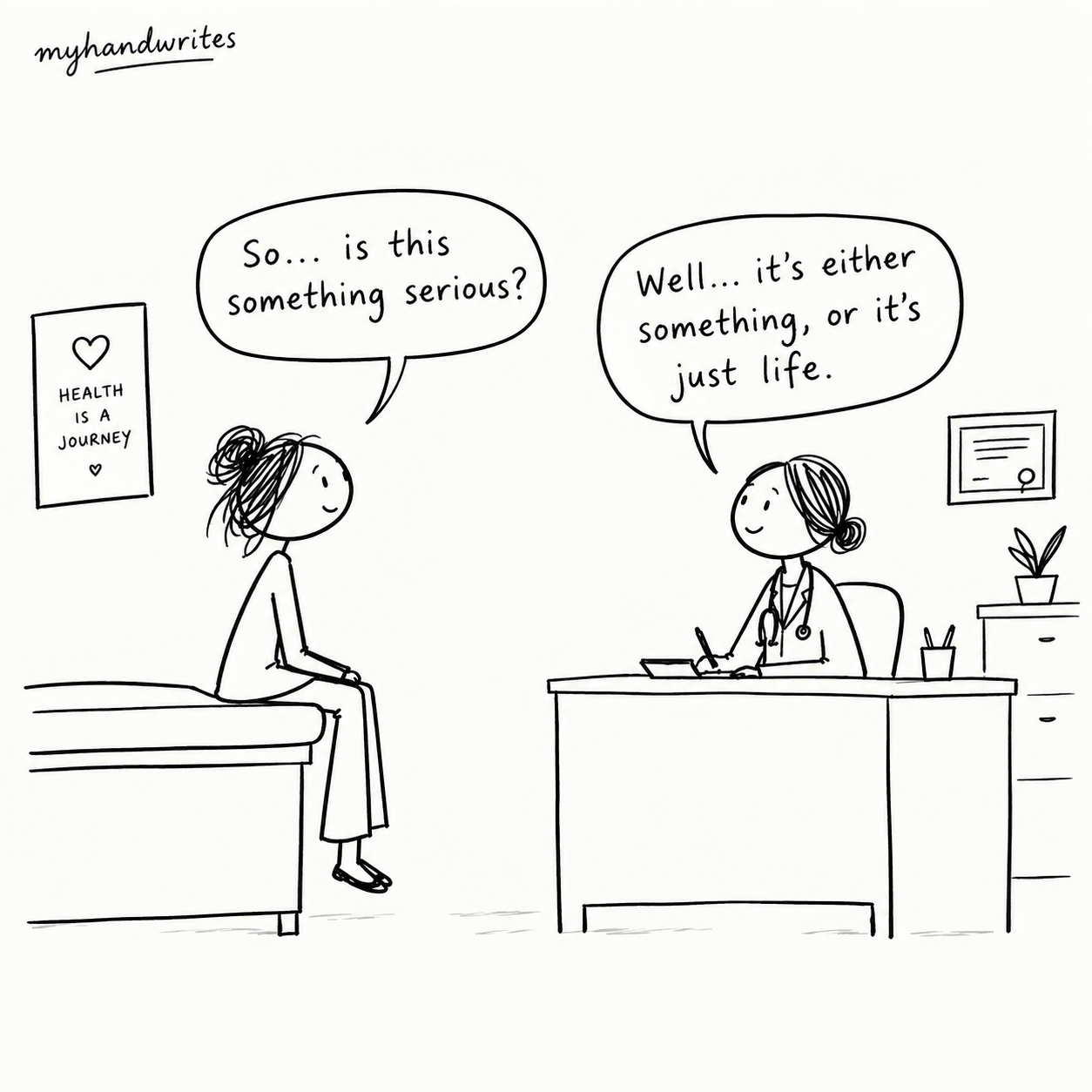
    I have spent the better part of my adult life trying to figure out whether something is wrong with me.

    It turns out I may simply have an unusually comprehensive collection of symptoms of being alive.


    25: Cancer

    At 25, I became afraid of cancer.

    There was a breast lump.

    It wasn’t cancerous, which was excellent news.

    It was also the beginning of my annual relationship with the healthcare system.

    “Come back next year.”

    There is something oddly reassuring about being told you’re fine, followed immediately by an appointment to make sure you’re still fine.

    For the next few years, I discovered that waiting for a medical check-up is a special kind of hobby.

    You spend eleven months forgetting about your body and one month remembering every sensation it has ever produced.

    A headache becomes suspicious.

    A twitch becomes interesting.

    You start wondering whether that thing you felt three weeks ago was actually there.

    The human imagination is an impressive diagnostic machine.

    Unfortunately, it has no off switch.

    28: Marriage

    At 28, I got married.

    I married an ambitious person.

    He was an Aries.

    I was a Cancer.

    At the time, this seemed romantic.

    In retrospect, perhaps we should have consulted a specialist.

    Marriage introduced me to another fascinating branch of medicine: diagnosing people who have not asked to be diagnosed.

    You notice things.

    You observe patterns.

    You read an article at 11:47 p.m.

    Suddenly, everything makes sense.

    You send the article to the person in question.

    They don’t respond.

    So naturally, you send another.

    Eventually you realise you have completed an entire medical residency without leaving the house.

    The patient, unfortunately, remains unconvinced.

    31: Fitness

    At 31, I decided I needed to get fitter.

    I discovered HIIT.

    HIIT is a beautiful concept.

    Take a perfectly functioning human being and briefly convince them they are being hunted.

    I was less enthusiastic about the boring parts of fitness — nutrition, recovery and gradual progression.

    My hip eventually provided the feedback.

    There was a diagnosis.

    Then surgery.

    Then nine months with a walker.

    Nine months is enough time to develop strong opinions about accessibility.

    Before that, I had never noticed how many places assume everyone can walk.

    Stairs.

    Curbs.

    Public transport.

    Some chairs.

    The walker, meanwhile, was wonderfully uncomplicated.

    It had one job.

    It did it every day.

    I began to understand why people like reliable friends.

    The 30s: Burnout

    Then came burnout.

    Once is unfortunate.

    Twice is a pattern.

    Three times is when you start wondering whether your life is trying to communicate.

    I had plenty of theories.

    Work.

    Ambition.

    Stress.

    Expectations.

    Relationships.

    Life.

    Possibly the fact that I approached adulthood as though it were an achievement unlocked by doing more.

    There is something comforting about having an explanation. If you know what caused something, you can imagine that fixing the cause will fix everything else.

    Humans are very good at this.

    Give us a complicated situation and we will immediately look for a culprit.

    Preferably one with a name.

    35: Parenting

    At 35, I had a child.

    Apparently, I was approaching the age where people start discussing having a “healthy baby” with the seriousness of a financial forecast.

    The baby arrived healthy. And with an imagination that seems to have no budget.

    His memory is also alarmingly good.

    Watching him remember things I have completely forgotten has occasionally made me question whether I was ever as intelligent as I thought I was.

    Parenthood made me incredibly efficient.

    It also made me incredibly tired.

    Apparently, those two things can coexist quite comfortably.

    38: A New Theory

    Then, at 38, things got strange.

    Strange enough that someone close to me noticed. There were conversations, professional advice, and a theory about what might be going on.

    A serious one.

    I won’t name it. Not because I’m being mysterious, but because I’ve finally learned that some things are better kept between a person and their doctor.

    Besides, the internet has enough diagnoses already.

    Mention one, and someone will appear with a checklist.

    “You have six of the symptoms.”

    Excellent.

    I also have six symptoms of being alive.

    At some point, I began wondering whether we have become slightly too enthusiastic about labels.

    We are uncomfortable with “I don’t know.”

    We prefer a word. A word makes uncertainty look organised.

    And perhaps that is what this chapter is teaching me: not everything needs to be named immediately.

    Maybe there will be a diagnosis. Maybe there won’t.

    For now, I’m learning to sit with the uncertainty. It is uncomfortable.

    But perhaps that, too, is a symptom of being alive.
  • Dear Destiny, Stop showing me Ads

    Dear Destiny, Stop showing me Ads

    Destiny is supposed to be written in the stars.

    Apparently, mine is also written in my cookies.

    We like to think our desires are deeply personal. Then an advertisement appears and suddenly we discover that we have always wanted a kitchen island, a six-pack, a silent retreat in Bali and a personality that says “I drink vodka but remain emotionally available.”

    Conveniently, the algorithm knows this before we do.

    It shows us a life we never knew we were destined for. We see it once. Then twice. Then seven times, because apparently destiny requires retargeting.

    Eventually, the desire starts feeling familiar.

    Familiar becomes possible.

    Possible becomes necessary.

    Necessary becomes: “I deserve this.”

    And suddenly we are making life decisions around something that arrived between two videos of a cat falling off a sofa.

    We buy the house. Book the holiday. Change the wardrobe. Download the productivity app that promises to help us finally become the person who has time to use the productivity app.

    Years later, we look back at the path and see a coherent story.

    “It was meant to be.”

    Perhaps.

    Or perhaps destiny has simply become very good at disguising a sales funnel.

    The strange part is that advertising doesn’t have to tell us what to think. It only has to become familiar enough that we eventually mistake recognition for desire.

    And then we call the desire our own.

    So perhaps the philosophical question isn’t whether advertising can influence our choices.

    It is – If someone can influence what we want without us noticing, how much of what we call destiny is actually just a very successful advertisement we forgot seeing?

    Perhaps, destiny isn’t written in the stars, but served to us because we once Googled something at 2 a.m.

    If this my destiny, I am indeed doomed.👿

    Dear Destiny,

    You have clearly missed my delivery window. You may as well find peace with another customer.

    May you rest in peace.

    Amen,

    Megha.

  • How was my August (2026)

    How was my August (2026)

    Last month was weirdly the most depressing and most interesting period of my life. If I could describe the feeling, it almost felt like virtual reality. (Déjà vu).


    I was on Summer Vacation.


    Well to start with I was in India for a vacation with my toddler (who is now almost 3). Did I tell you I had a son? He’s a charming boy, a genius – who knows how to press all my buttons.

    I imagined taking him on vacation to India with my partner so he meets his grandparents. I hoped this would give me some time off. Some time to relax.
    But hell broke loose when we reached there.


    For starters, he needed the level of attention I could never manage even in the Netherlands. You see, I have a sitter in the Netherlands and he enjoys playing with her so much. I’ve outsourced care at home for my sanity. Set a system that works for him and me. Chose to not put him in daycare (Those institutions are meant to break the soul of kids in my opinion. I wish more parents read the work of Gabor Mate).


    Anyhow, on our vacation in India, my son wanted to play all day. I wanted to rest. All others in the house who could play with him were either working or in school. Within only two days of the vacation, I was missing our dear sitter and wished to go back to Netherlands and end that energy draining vacation.

    To top my frustration, my dad got hospitalised. He thought he was having a heart attack. Turns out he had low sugar. I spent all night chatgpting his symptoms. I realised I could have as well been a doctor. ( and a very good one). Anyhow he turned out all fine so that was a relief.

    On my vacation, I was excited about an office assignment that just fell on my plate. I finally felt it was my gateway to promotion. (If that was in the pipeline?!). I spent a night copiloting and chatgpting to excel the assignment. I ended up learning corporate politics and how power works. Realised I didn’t know much about the banking industry actually. (after 15 years of working). Anyhow, few hours spent in the night and I got excellent outcome ready for the assignment. I patted myself on my back that night and slept well.

    The next few days I spent pondering what was I actually doing and why was I working.. what if promotion never happens in my existing setup.. who could I replace in my organisation.. why was I paid so low? . (What is the purpose of this life? Purpose should actually not exist in NLP model. Gawd! I was enlightened and very creative the rest of the period.).

    Fast forward a week or so, vacation ended finally and I was back to the Netherlands and heaved a sigh of relief to be back to my normal routine. (At home and work)

    Office here I come

    After arriving back in the netherlands, work was on my mind.

    I had an excellent case ready for promotion (or replacing someone in another position) , just climb the ladder in any god damn case.

    But somehow things started turning awry. Like really really weird. I can’t even explain the next series of events I encountered. They haunted me for the rest of the month.

    My laptop felt like it was hacked (malfunctioning), I was working, networking, tried medication to sleep, felt like I was on the edge of burnout but was not, I became super creative and then found out I was put on bench at work.

    My manager thinks I am burned out. (Does she even know what burn out is? I have a goddamn website to explain it. Someone should make her read it).

    Outcome and Personal

    I am now on forced leave at work.

    I am actually liking the fact that I can write and can do things I always wanted to do. Planning to set up a company for my new brand OutoftheBurn.

    Personal life sucks. Separation has been on my mind. Has been on my mind for last seven years or so. (Right after my first burnout in 2018). With a kid involved now, this is super difficult. I am riding the waves, Solo!. (And venting on every forum I’ve ever known).

    <Dear GOD! I might as well start believing in you if this crazy phase of my personal life just got over. I know I deserve better.>


    August Book suggestions


    In August, I did read some books.
    For anyone in new role or job, I would highly recommend First 90 days by Michael D. Watkins. I’ve read it halfway and found it very interesting.


    For anyone exploring burnout, I would recommend the book Discover your mental strength from Michael Kortekaas. He has been training police forces in the Netherlands for almost all his career and teaches mental resilience for the profession that is most demanding.

    I’m not done reading both books but I will post a review as soon as I finish them.
    Below are also some books I would recommend if you are planning a career to become a CRO or CEO eventually. (These popped up from my research in August and I’ll pick them up on one of the days. )

    Thinking, Fast and Slow — Daniel Kahneman

    The Fifth Discipline — Peter M. Senge

    The Fearless Organization — Amy C. Edmondson

    Good Strategy/Bad Strategy — Richard Rumelt

    Leadership Pipeline — Ram Charan, Stephen Drotter & James Noel

    The Effective Executive — Peter F. Drucker

    Team of Teams — Stanley McChrystal

    Principles — Ray Dalio

    The Culture Code — Daniel Coyle


    What Else is on my mind?


    I’ve been thinking of three quotes lately. They have been a lot on my mind.

    One person can change the world, not by being powerful, but by making something different possible.
    — Author unknown


    A hallucination becomes dangerous not when we see what isn’t there, but when we stop questioning what we see.
    ~ Unknown Author


    What you seek is seeking you.
    ~Rumi


    Signing off. Until I see you next time. (Wake me up when September ends!)
    ~ Love Megha.


  • 0% Alcohol living

    0% Alcohol living


    In 2018, I was in Belgium. I remember going to the beer festival for the very first time. At the heart of the city center in Bruges was this small ground with hundreds of tents and locally brewed beers on sale. There were more than 200 variety to choose from. Sour beer, fresh hops, IPAs, Lager, Pilsner and what not. Me and my partner waited in a queue for more than an hour to purchase the tokens for the fest. I didn’t know how many tokens to buy until we were actually short of them. That’s how we knew – we had enough. We tasted a dozen that day.
    I was a social drinker back then and loved exploring. I wanted to even take up a brewing course.

    Following years were not the same.

    In 2020, I suffered an injury.
    My hip bone was damaged. I spent a month in extreme pain, thinking it was a sprain. Following up revealed that I might need a hip replacement. I was 31 back then and it scared the sh*t out of me.

    It didn’t come to that. (Fortunately!)

    An interim treatment worked. I spent six months on walker and it took a year of physiotherapy to resume my day to day activities. During that period, I was bound to stay away from alcohol. Alcohol free lifestyle happened to me.

    My first few months of zero alcohol living did not come easy. After a tiring work week, I felt the desire to have a drink. I craved social drinking on weekends. I couldn’t eat pizza without a beer. I missed wine while eating pasta or meat. All that was fun, was stripped away. My plight grew stronger when I met family and friends in social setting. Everyone drank. Everyone laughed. Everyone was light headed while I was wide awake and sharp, struggling to let go my consciousness.
    It was hard to remain comfortable in my own skin.

    So,I was pushed to find alternatives. To break free from the associations I created in my mind; dissociate socialising from alcohol. Cola became my companion soon. It was a great replacement for some time. (Of course after a while, you’ve got to leave it coz you get addicted to it.) I tried mocktails, juices, sparkling water, coffee, tea and everything that was categorised under non-alcoholic beverage section.

    After close to ten months of this new lifestyle, I discovered I was no longer craving for wine or beer with food. My craving to eat junk food also reduced. I could sit in a pub full of people drinking, and still enjoy a normal conversation. I lost more than eight kilos merely by cutting down alcohol. I felt this new energy inside me.

    Alcohol free living also did wonders to my emotional health. I realised when I didn’t drink after a stressful day, I was left open to introspect, to think what caused the stress in first place. Not numbing those thoughts was the best choice I made for myself.
    It pushed me to accept my reality, act on it and change my environment.
    I’ve found myself in a much happier place since then. So, I decided to sustain the lifestyle ever since.

    It has now been more than two years since I went on no alcohol regime. I’ve learned to be comfortable in my own skin while I consciously choose to stay alcohol free. It gives me a sense of control over my well being. I still love the smell of hop every time I sit in a pub. Guess that’s why they invented the 0% beer. (for people like me. 🙂 )


    © Copyright 2022. Megha Gupta. All rights reserved.

  • Being Overly Competitive


    Ever met someone in your life whose sole purpose of living seemed to compete?
    Did you not wonder what keeps them going?
    What was it with their unstoppable desire for power?
    When would they be at peace?


    I was born in a third world country where competition was inculcated from a naive age. It was hard to do things for the sake of doing. You did what you did coz it earned something. Everything else was deemed worthless.

    Competition was a requisite to earn money. Money meant success and success brought happiness. Wasn’t that the key to living?
    At least that’s what I grew up believing!

    Later in my twenties, I moved to Europe.
    I was amazed with the pace of life. Honestly, taken aback a bit. 🙄
    People were satisfied with what they had. It didn’t matter what you did coz whatever you did earned a living. With that being sorted, there was time to discover likes (& dislikes). Whatever that meant! 🧘‍♂️ Success was more than money. It didn’t mean relentless chasing.

    For the first time in many years, I stopped to examine the purpose of living.

    What I learned in the process helped me pin down the roots of competition. In this post, I share my hard earned two cents of wisdom.

    Comparison drives competition.

    What do you want?” is a scary question for most people. We are barely aware of what we want in life, let alone understand our purpose of living.

    People define success by looking at what others want. Their concept of self-worth is based on external validation. As they compare and compete, surreal benchmarks of happiness get defined each day.

    Key to remember though is that comparison comes from a place of insecurity. When we’re not sure of what we want, we look at what others want.

    If we don’t ourselves define the meaning of success and happiness, it gets defined for us. Competition can then become an endless chase, a misery.

    Competition, my mate is driven by Ego (mostly).

    You’d be lying to say you have no ego. It’s that part of your personality that protects your unique identity. When “me” starts feeling put down, the competitive side kicks in. You won’t care what others think, say or feel, coz you’d want to believe you are right. You’d compete to prove yourself, to re-assure your identity. (to save your ego)

    But does that make it a wrong reason? Err… I say no.
    Ego is merely a self defence mechanism to protect your emotional well being. All it does is reinstate the fact that YOU exist, you are unique and you are right. It therefore drives you to compete, to put yourself out there in that chaotic world, where everyone else is also learning to co-exist.

    Beware that some people are more egoistic than others. Naturally, they are therefore more competitive. Extreme ego leads to narcissism – one of the traits of overly competitive.

    But some compete out of scarcity.

    Now this one kinda seems obvious. When resources are limited, everyone pulls each other down to make the most of it.
    Put with a bunch of crabs, trying to come out of shit hole, you’ve got to learn to compete. Don’t you?

    What is tough then is to let go this tendency, when you’ve reached your place of abundance. That doesn’t happen automatically.

    So, how do you know if you are an overly competitive person?

    So one thing I’ve learned is that there is nothing wrong in being competitive.
    Competition gives you a nudge to be your best self.
    Being overly competitive though is problematic.
    It affects YOU (without you realising it) and those around you (without you acknowledging it).

    Ask yourself three questions.
    1. Are you constantly thinking about getting ahead of someone?
    2. You don’t worry how others feel about your chase?
    3. Do you feel stressed emotionally and maybe physically?

    If the answer to any of the above is yes, then you my mate are overly competitive. You are far from knowing your true purpose and cutting the chase is necessary.

    Are you a sufferer making those around you suffer? (Irony, that is).

    What would it take for you to realise this?


    © myhandwrites. Megha Gupta. All rights reserved.

  • A different pace of life in the Netherlands


    It has been a week since I returned to the Netherlands, and honestly, I feel a bit weird getting back here. For starters, it’s a corona-free nation. (Or at least looks like it).As opposed to India, where paranoia from the deadly wave persists, Netherlands looks rash. When I came out of the airport with my mask on, I drew quite some attention from people around. None had their face covered. It was like they stopped manufacturing face masks in the Netherlands. I was disappointed, of course, because I brought like a thousand in my luggage, and now they’re just sitting in my cabinet, waiting for the next wave!

    Walking around in the evening felt strange too. Pubs, Bars, and Cafes were open late. Both indoors and outdoors were jam-packed with people enjoying beer, chit-chatting.

    I kept thinking about my time in India. People walked on the pavement in their apartments. (with masks on). Kids stayed at home, attending online classes. We spent days inside, watching television and ordering food. It was like living in a constant state of fear and getting so accustomed to it that any normal would make you feel guilty.

    After close to two months of being there, I’m back in this free country. And must I say –
    It is damn hard to switch. No one seems to care about rules or Covid, and I’m having difficulties tuning in. The pace of living is getting to me.
    I am anxious ‘coz I am missing out on living.


    © Copyright 2021. Megha Gupta. All rights reserved.

  • Furiously Happy – Book Review

    Does the cover of this book make you smile? (because I completely fell in love with it. so much so that I bought the kindle edition last month.) That scary-looking, overly delightful raccoon is very much real. (except that it’s dead and taxidermied by the author.)


    In her book “Furiously Happy” Jenny gives a peek into her insanely overworked mind. She talks about her cats, her therapist, a “normal” husband, and everything – hamster, Australia, Galileo, Parsley, and whatnot. Behind every weird conclusion she makes is a bulletproof theory that she invents with an overly creative mind. Jenny also talks about her experiences with depression and anxiety with candid honesty. She is very expressive about how she feels in her lowest days, how she handles the fear, the success and persisting condition of mental illness. Her courage to talk about these topics in such details is the soul of this book.

    Jenny’s writing style makes you connect with her instantly. Reading it felt like sitting inside her head.

    I saw Anne Frank trending on Twitter and I thought she’d died. Again. Turns out it was the person who found her diary that died. She’s fine. And by ‘fine’ I mean ‘still dead.’ Not that I think that it’s fine that she’s dead. I just think it’s fine that she’s not back from the dead. No one needs an Anne Frank zombie.
    ~ Jenny Lawson, Furiously Happy

    I try not to get caught up in appearance issues though because my grandmother always used to say, “It’s what’s inside that counts.” And that’s probably true because with my luck my best feature would be hidden deep, deep inside my body. I suspect my best feature is my skeleton, which is a shame because it might be the most elegant and hauntingly graceful skeleton ever but I’ll never get complimented on it while I’m still fleshy enough to appreciate it. That’s why I’d like people to say “Nice skeleton” to me now. Just give me the benefit of doubt, you know? “
    ~ Jenny Lawson, Furiously Happy

    It took me over a month to finish this book. Not that it’s lengthy, but because it’s a series of essays, each with a very distinct title. That’s why I found it a good bedtime read. There are some parts in this book where you think the author is rambling on, but I guess that is really how an anxious mind looks.

    I’ve learned from reading this book that it’s hard to dislike someone when they are so genuine. I, therefore, recommend this book for its original style. It would make you laugh while giving you a perspective on what it feels like to be anxious or depressed.

    Four stars for Jenny Lawson’s Furiously Happy!
    (She did make me happy)

    Rating: 4 out of 5.

    © Copyright 2021. Megha Gupta. All rights reserved.

  • ..

    It’s been over a month since I travelled from the Netherlands. So yes, I’m back here again.
    In India. (I mean). I had to travel this time to cope with the aftermath of the corona crisis.

    I don’t reckon many acquaintances who haven’t suffered the second wave.
    While I feel sorry for losing my relatives, I feel favoured to have a family (Alive!).
    They weren’t spared from this wave either. They crawled through the mess. (this time)
    Fear drives our routine now.
    Nobody steps out of the house. No stranger gets in.
    I’m not sure how long this would continue and when we’d recover from the paranoia.

    I wonder if this is our new normal, or are we just being unreasonable?
    P.S – It’s hard to forget what you can’t forget.