Category: Creative

  • Be Yourself. At Your Own Risk.

    Be Yourself. At Your Own Risk.

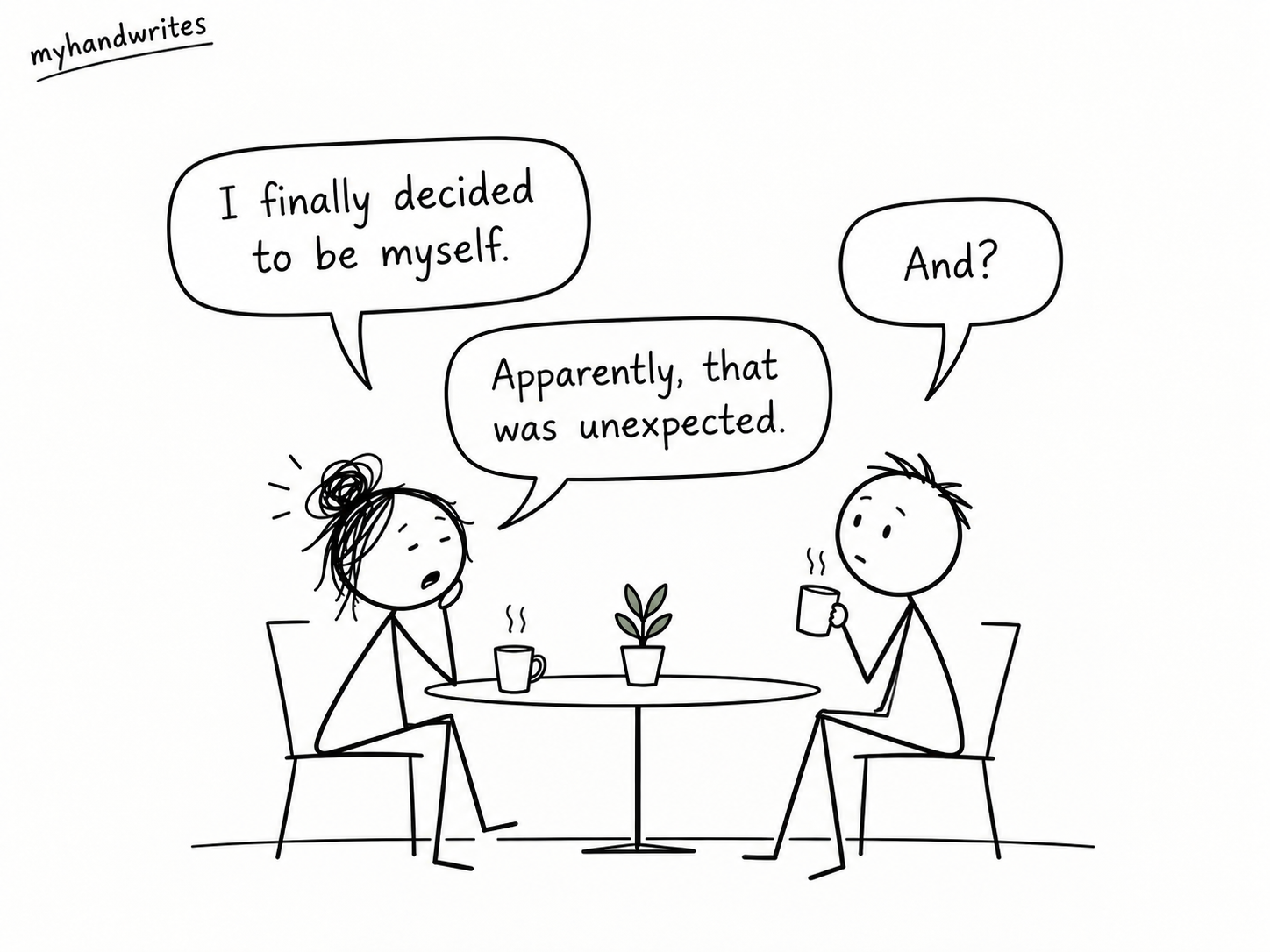
    Everyone encourages authenticity. It’s one of those things people enthusiastically support until someone actually tries it.

    At work, authenticity is a leadership quality. There are workshops about bringing your whole self to work, which is ambitious considering most people struggle to bring a functioning brain to Monday morning meetings. Tell someone their presentation could have been an email, and suddenly there’s a conversation about communication skills. So people say “Interesting perspective” while holding an entirely different meeting inside their heads.

    At home, authenticity requires parental clearance. A fully grown adult with a job, a toddler and a mortgage mentions needing space. Within days, the parents are concerned. “Are you unhappy? Is everything okay?” Your authentic self enjoys breathing room. The family has initiated mental health investigation, complete with follow-up calls.

    With friends, authenticity can get awkward. You may admit that juggling work, parenting and relationship is exhausting. A friend responds, “I’m just lucky that my partner is supportive!” You’re thinking “Wonderful. Congratulations on your excellent domestic infrastructure.” Your authentic self has several responses. The socially acceptable self smiles and orders another coffee.

    On LinkedIn, authenticity is encouraged, preferably with professional photographs and three leadership lessons. A terrible Tuesday must become “Five Things Adversity Taught Me About Resilience” by Thursday. Being genuinely vulnerable risks judgment. Being polished risks becoming indistinguishable from everyone else.

    The trouble with authenticity is that it comes with consequences. Someone might disagree, take offence or decide that the original version was better left unpublished.

    So people edit themselves. A little at work, a little at home, a little with friends. Some editing is necessary. Nobody needs unrestricted access to every thought that crosses someone else’s mind.

    But how much editing is too much? Being yourself might cost you someone’s approval. Pretending might earn you plenty of it.

    The awkward part is deciding whose approval matters more: theirs or your own.

    And neither comes with a money-back guarantee.

  • The Evolution of FOMO

    The Evolution of FOMO

    FOMO probably has its roots somewhere in a forest.

    Imagine a group of early humans standing around when suddenly everyone starts running. You look around. Nobody explains anything.

    You have two options: run with them, or stay where you are and discover whether they were escaping a tiger.

    Evolution probably decided this was a terrible moment for individualism. So it gave us FOMO: “You are missing something. Move.”

    It was a useful survival mechanism. The tiger was real. The danger was real. The consequences of missing the group could be real.

    Thousands of years later, the tiger is gone. The mechanism remains. And now it has Wi-Fi.

    FOMO at work is very sophisticated. Someone gets invited to a meeting you weren’t invited to, and suddenly you need to know what happened. You didn’t want the meeting. You didn’t even know the meeting existed. But now three people have discussed something without you and apparently your career is in danger.

    FOMO on weekends is equally rational. You planned to stay home, drink coffee and do absolutely nothing. Then you see someone having brunch in beautiful sunlight. Suddenly your peaceful Saturday feels like a failed life choice.

    Social media took FOMO and gave it industrial-scale distribution. You can now discover that someone is travelling, getting promoted, buying a house, running a marathon, falling in love, launching a company and making sourdough. All without leaving the sofa.

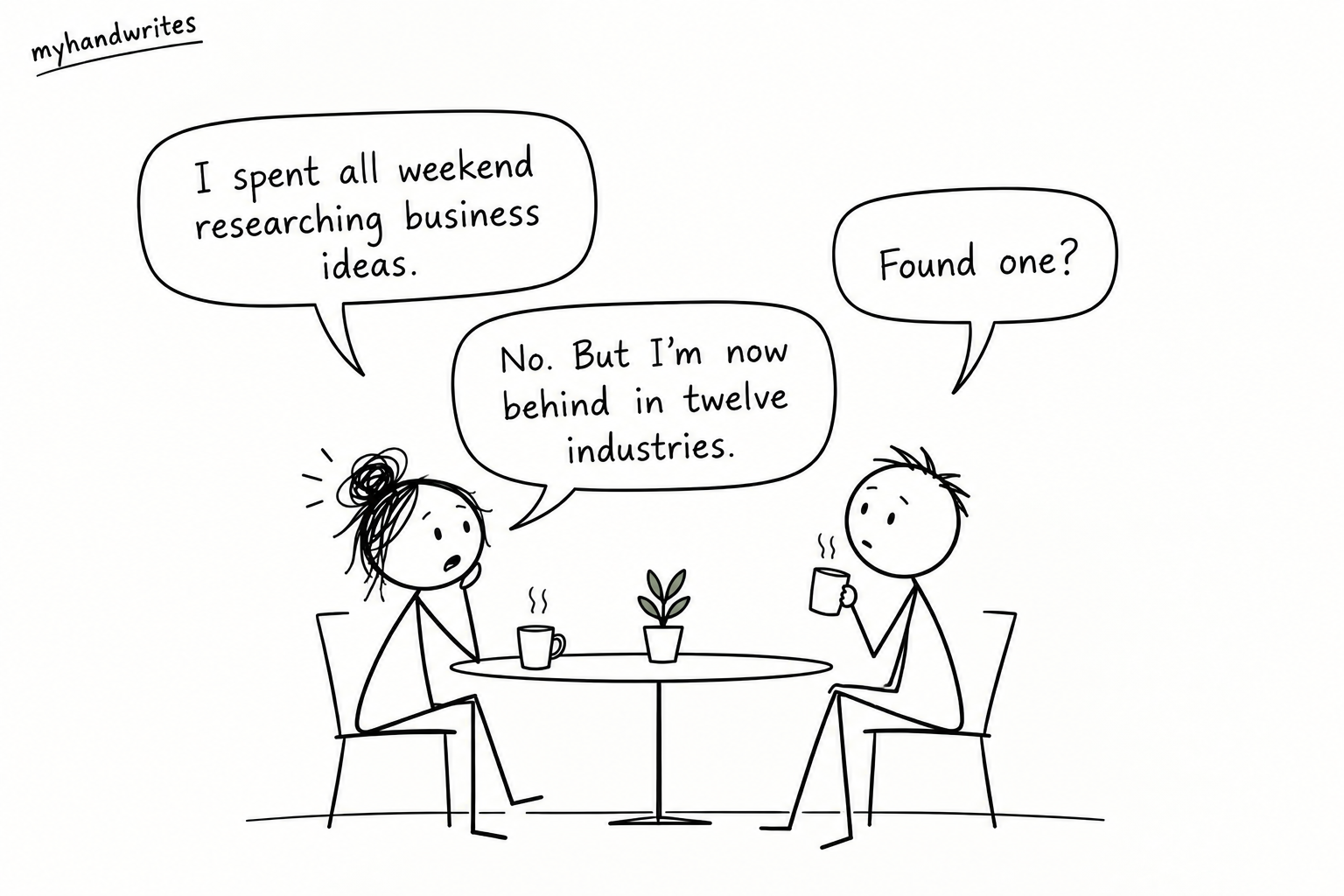
    FOMO becomes particularly creative when you start a parallel business. Someone launches a newsletter. You should have started one. Someone creates a course. Perhaps you should create a course. Someone builds an app. Maybe the app is your calling.

    Someone changes their LinkedIn headline.

    You panic.

    Meanwhile, you have spent three hours choosing a font.

    And then there is parenting.

    Your child is happily playing with a cardboard box.You see another child doing ballet, swimming, Dutch, chess and something called “creative STEM exploration.”

    You look at your child.

    Your child looks at the cardboard box.

    You think: “Are we failing?”

    The child continues playing with the cardboard box.

    The cardboard box is winning.

    Perhaps that is the strange thing about FOMO. The brain was designed to keep us from missing the tiger. Somehow, we taught it to worry about missing brunch, meetings, business ideas and Dutch lessons.

    But perhaps FOMO is asking us to solve an impossible problem: how to live every life we could have lived.

    We can’t.

    Every choice quietly closes a thousand doors. Every life contains roads we will never take, places we will never see, people we will never become, and versions of ourselves that will remain imaginary.

    That isn’t the tragedy of being alive.

    It is the price of becoming someone.

    Perhaps peace begins when we stop asking, “What am I missing?”

    And start asking, “What am I here for?”

    ~ Megha.

    Author @ myhandwrites

  • The Trouble With Pressure

    The Trouble With Pressure


    I’LL JUST GET THROUGH THIS WEEK.

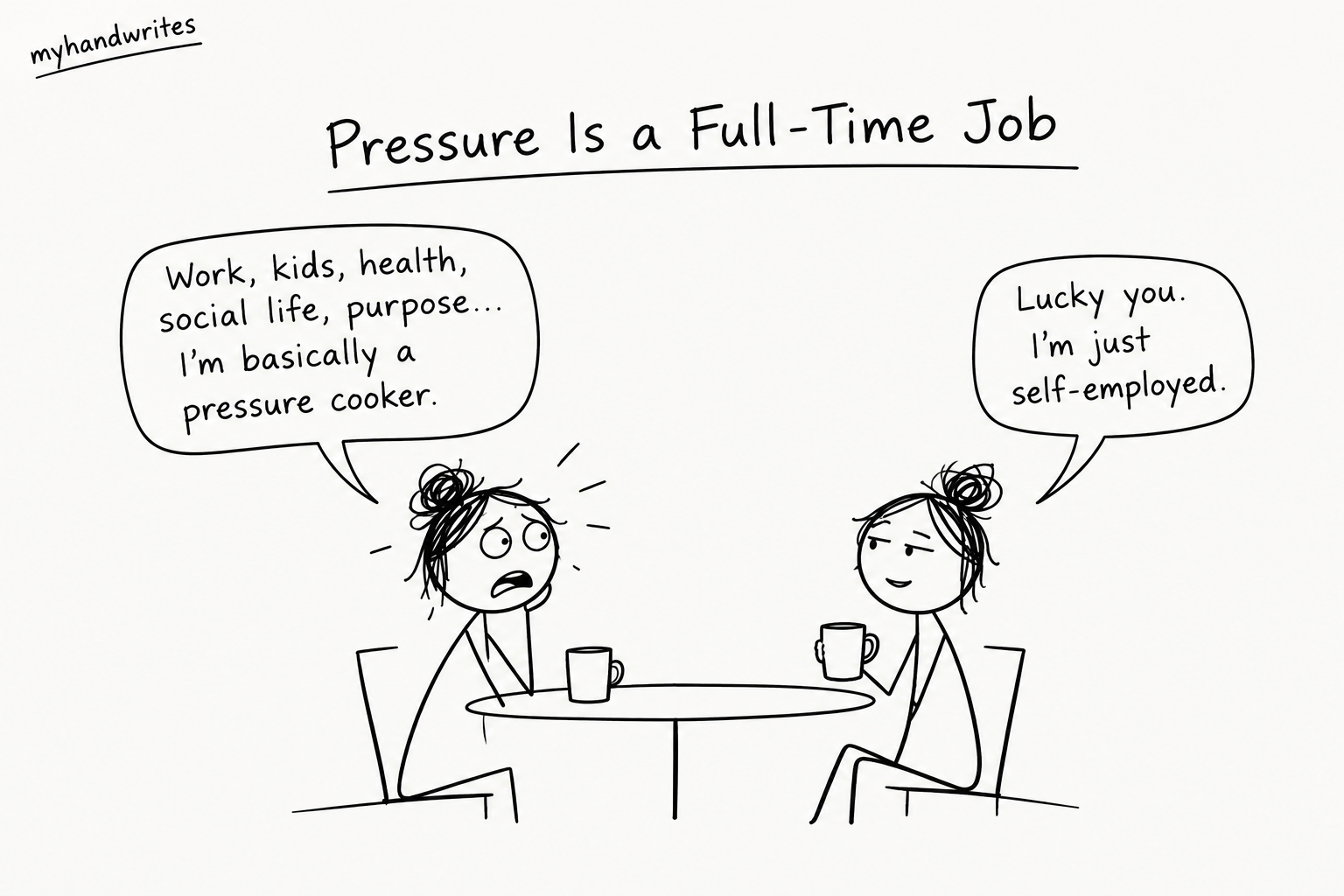
    Work pressure is a bit like tyre pressure. Too little and you don’t get very far. Too much and eventually someone starts checking whether you’re about to explode. So we keep adjusting it. One more deadline. One more meeting. One more “quick thing.” One more email sent at 11:47 p.m. Eventually, being permanently inflated starts looking suspiciously like competence.

    WHY IS THE BANANA BROKEN?

    Parenthood comes with its own pressure. More like a hot-air balloon. You keep adding air and hoping everyone stays airborne. Breakfast. Shoes. Nursery. Lost teddy. Forgotten water bottle. A child crying because the banana has been cut incorrectly. Somehow you are responsible for keeping another human emotionally stable while you haven’t had coffee yet. And still, every morning, you launch.

    MY WATCH SAYS I’M DOING IT WRONG.

    Then there is health pressure. Sleep eight hours. Exercise. Eat vegetables. Drink water. Reduce stress. Get enough sunlight. Your phone reminds you to stand. Your watch judges your sleep. Your app congratulates you for walking 8,000 steps, but quietly lets you know that 10,000 would have been more appropriate. At this point, you’re not sure whether you’re looking after your body or managing it.

    WHAT WILL PEOPLE THINK?

    Social pressure is particularly impressive because nobody actually hired us for this job. Yet somehow we know the requirements. Have a good career. Be a good parent. Look healthy. Travel. Have hobbies. Be successful, but not annoyingly successful. Be happy, but not suspiciously happy. And whatever you do, make it look effortless. There is apparently a performance review happening somewhere. We just haven’t found the manager.

    SO… WHAT IS YOUR PURPOSE?

    And then, just when you thought being alive was enough, someone asks about your purpose. You need a calling. A mission. A five-year plan. Ideally something that sounds good on LinkedIn. We are expected to know what we want to do with our one precious life while occasionally forgetting why we walked into the kitchen.

    Maybe pressure isn’t always about how much we can handle.

    Maybe sometimes it is about how many things we have quietly decided we are supposed to handle.

    And perhaps the first pressure valve is simply admitting:

    Some of this is ridiculous!

    ~ Megha.

    myhandwrites.com


  • The Shame Department

    The Shame Department

    Shame has an extraordinary memory.

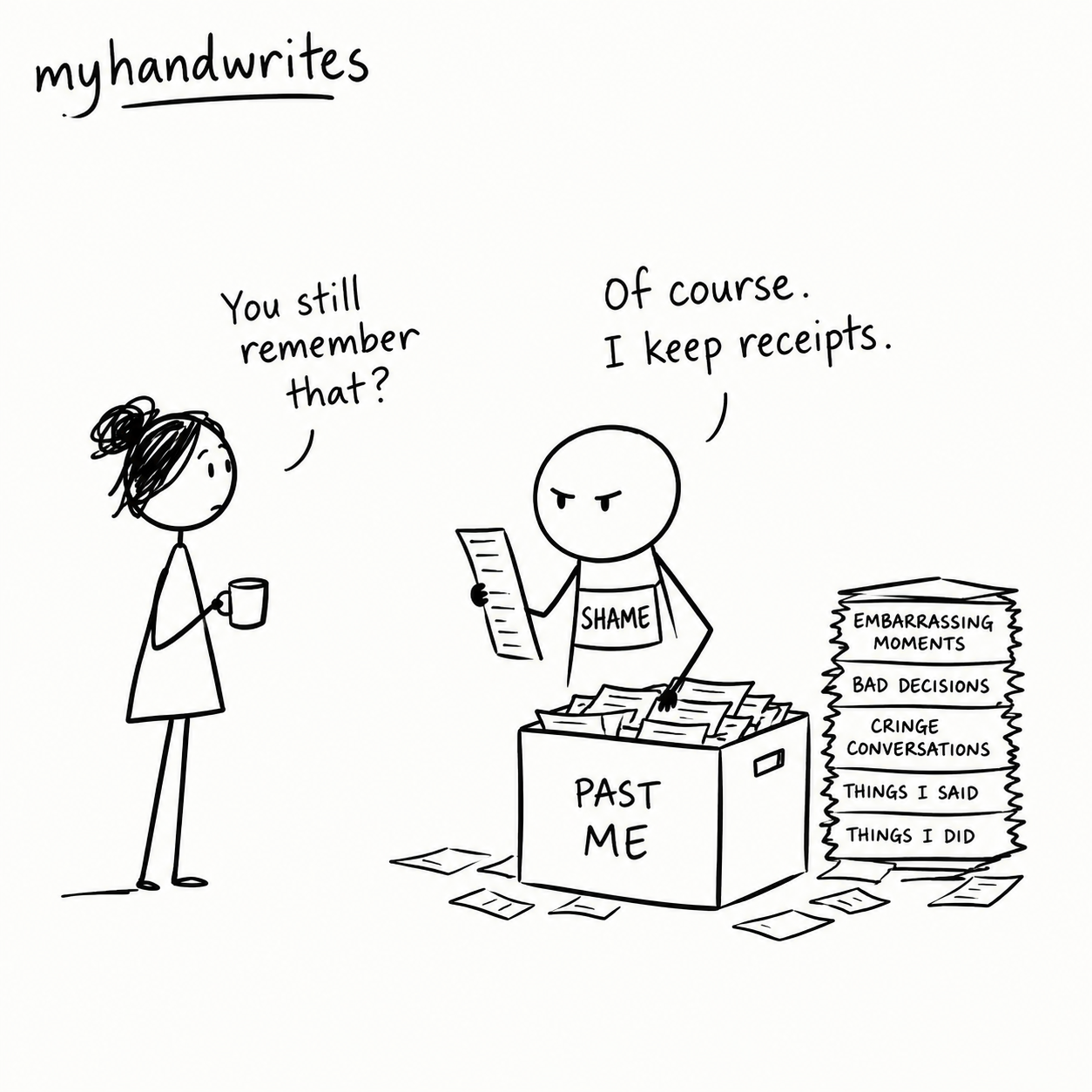
    You can forget your mother’s birthday, your Wi-Fi password and why you walked into the kitchen. But shame remembers the exact sentence you said at a dinner party in 2018 that nobody else remembers.

    Nobody.

    Shame does.

    It probably has it backed up to the cloud.

    Shame also has impeccable timing.

    You can be having a perfectly good day when it suddenly walks into your brain wearing a tiny security badge.

    Shame : “ Excuse me. We have an incident from 2024.”

    Me : I don’t work here anymore.

    Shame : “That is not relevant.”

    Shame doesn’t care much for your achievements either.

    You could get promoted, buy a house, raise a child and finally learn how to fold a fitted sheet. Shame will still be interested in that one time you said “you too” when the waiter told you to enjoy your meal.

    Somewhere in your brain, this has been classified as a national emergency.

    Then shame gets creative.

    It takes something you did and turns it into something you are.

    You lied once. Now you’re a liar.

    You behaved selfishly. Congratulations. Your new job title is Selfish Person.

    You embarrassed yourself. Apparently this wasn’t an incident. It was a branding exercise.

    Shame has the remarkable ability to turn a thirty-second event into a lifelong personality assessment.

    And it doesn’t believe in character references.

    If a friend told you about something embarrassing they did ten years ago, you’d probably say, “You were young. You didn’t know better. You’ve changed.”

    But when it’s your own story, suddenly you’re the judge, jury and deeply disappointed HR department.

    No mitigating circumstances.

    No appeal.

    Just a lifetime sentence handed to someone who has already served the crime.

    Maybe that’s the strangest thing about shame.

    It keeps prosecuting people who no longer exist.

    The person who said that thing is gone.

    The person who made that decision has learned a few things.

    The person who behaved badly has accumulated several software updates since then.

    And yet shame keeps opening the same case like it’s waiting for a different verdict.

    Perhaps we should stop giving it shelf space.

    It can keep the receipts.

    It can keep the screenshots.

    It can even keep the embarrassing footage.

    But maybe it can put everything in a box, label it “Past Me,” and move it to the basement.

    Somewhere between the Christmas decorations and that mysterious charger nobody knows what it belongs to.

    Out of sight. Not erased.

    Just no longer running the house.

  • Dear Destiny, Stop showing me Ads

    Dear Destiny, Stop showing me Ads

    Destiny is supposed to be written in the stars.

    Apparently, mine is also written in my cookies.

    We like to think our desires are deeply personal. Then an advertisement appears and suddenly we discover that we have always wanted a kitchen island, a six-pack, a silent retreat in Bali and a personality that says “I drink vodka but remain emotionally available.”

    Conveniently, the algorithm knows this before we do.

    It shows us a life we never knew we were destined for. We see it once. Then twice. Then seven times, because apparently destiny requires retargeting.

    Eventually, the desire starts feeling familiar.

    Familiar becomes possible.

    Possible becomes necessary.

    Necessary becomes: “I deserve this.”

    And suddenly we are making life decisions around something that arrived between two videos of a cat falling off a sofa.

    We buy the house. Book the holiday. Change the wardrobe. Download the productivity app that promises to help us finally become the person who has time to use the productivity app.

    Years later, we look back at the path and see a coherent story.

    “It was meant to be.”

    Perhaps.

    Or perhaps destiny has simply become very good at disguising a sales funnel.

    The strange part is that advertising doesn’t have to tell us what to think. It only has to become familiar enough that we eventually mistake recognition for desire.

    And then we call the desire our own.

    So perhaps the philosophical question isn’t whether advertising can influence our choices.

    It is – If someone can influence what we want without us noticing, how much of what we call destiny is actually just a very successful advertisement we forgot seeing?

    Perhaps, destiny isn’t written in the stars, but served to us because we once Googled something at 2 a.m.

    If this my destiny, I am indeed doomed.👿

    Dear Destiny,

    You have clearly missed my delivery window. You may as well find peace with another customer.

    May you rest in peace.

    Amen,

    Megha.

  • This Summer – The Crow Collection

    Usually, I write about my opinions and experiences. Sometimes, grave and sometimes funny. But this post takes a very different route as I feel creative this week.


    So tune in your expectations while I take the creative liberty to bring forward a clothing style that I like to call “The Crow Collection”. 😛 Inspired from the Crow, some of these designs may seem sharp and eerie.

    1. Emily : The American CROW

    This one is an American Crow. The sharp black edges at the top resemble the beak of the crow.

    Her shoe styling complements the sharp edges of the top!

    Overall Style – Sharp & Cutting


    2. Annisa : The Indonesian Crow

    This one is a bright Crow. I call her an Indonesian Crow as she looks somewhat Asian and reminds me of the beautiful sunny beaches in Bali.

    Her beautiful curly hair are contrasted by sharp geometrical edges of her clothes. The bright yellow color of the clothes gives her a casual look.

    Overall Style : Colorful Casual balanced with geometry


    3. Freya : The Nordic CROW

    I call this one a Nordic Crow as the color of her clothes reminds me of a Scandinavian country.

    Her top is grey with pipe like structure and resembles the wings of a Crow. Bottom is a long black, devilish looking hem.

    Her hair looks neat and she wears a goggle representing the cool & calmness of Nordic countries. (in stressful times like these).

    Overall Style – Modern and Cool.


    4. Zhang Xiu Ying : The Chinese Crow

    Well, I like to call her – a Chinese Crow. She could as well be a Japanese, Korean or some other Crow but I like to stick with Chinese version mainly because China is so much in news that it’s on top of my head right now.

    Her clothes are designed in shades of grey with sharp dividing lines. The close shades symbolize the many close varieties of a Crow.

    Overall Style : Transitional and sharp


    5. Menaka : The Indian CRow

    Now, I call this one as an Indian crow, mainly because of the colors and design. Her attire reminds me of hand woven clothes and embroidery in India. If you look at her top, it resembles a flying crow.

    Overall Style : Colorful traditional with a hidden crow.


    So, that ends my “Summer Crow collection”. I hope you had fun watching it. 😉

    Do you like any of these? Then cast your vote and maybe we can call out a winner. 😀


    © Copyright 2020. Megha Gupta. All rights reserved.